

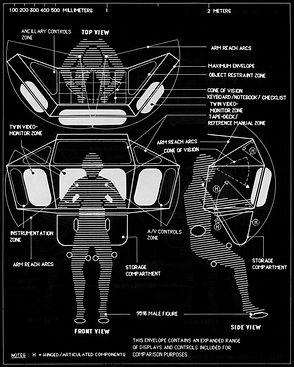

The human body adopts an altered profile in weightlessness caused by the absence of gravitational loads on the muscles and skeleton. Body posture becomes more simian in nature. Arms angle outwards with bent elbows, thighs angle upwards with bent knees, heads bend down. Attempts to maintain normal 1-g posture, such as straightened legs when standing upright, produces discomfort. Posture in weightlessness is referred to as neutral body posture and results in anthropometric and ergonomic design standards that are quite different to those on Earth. Understanding the architectural implications of these is essential to ensure physical comfort and functional efficiency in the cramped environments of space modules. For architects and designers, there is a learning process to go through to become familiar with these changes. These diagrammatic examples, generated as part of a larger NASA project, were an exercise in understanding how the changes influence the design of worksurfaces and workstation envelopes in weightlessness. The human body profiles in the diagrams represent the widest percentile size range from 95% male to 5% female.